Apple Maps Ads: What Marketers Need to Know
Learn how Apple Maps Ads work, where they appear, how businesses can use them, and why search intent makes this advertising channel worth understanding
Apple Maps Ads let businesses pay for visibility inside Apple Maps when people are discovering or actively searching for places.
For local businesses, that creates a paid acquisition opportunity at one of the most valuable moments in the customer journey: when somebody is deciding where to go.
This matters because Apple Maps gives advertisers access to a high-intent local search surface.
And no, this is not simply Apple Search Ads copied into Maps.
Apple Maps Ads are built for physical businesses. The objective is not an app install. It is getting someone who is already looking for a place to take an action: call the business, open its place card, get directions, or visit the location.
That distinction is important.
If you have worked with Apple Ads on the App Store, the logic will feel familiar: capture demand at the exact moment somebody is searching. But the conversion happens offline instead of inside the App Store.
What are Apple Maps Ads?
Apple Maps Ads are paid placements for businesses inside Apple Maps.
According to Apple's official Apple Maps advertising page, ads can appear when people are looking for nearby businesses and places.
Apple says more than one billion relevant searches for businesses happen on Maps every month, and that one in two searches for a business leads to a user taking an action.
That is exactly why this inventory is interesting.
A search such as:
- coffee near me
- sushi restaurant
- sporting goods
- hotel
- pharmacy
- bike shop
is not passive browsing.
There is usually intent behind it.
This is the same reason search advertising has always been so valuable. You are not interrupting somebody and trying to manufacture demand. You are showing up when the demand already exists.
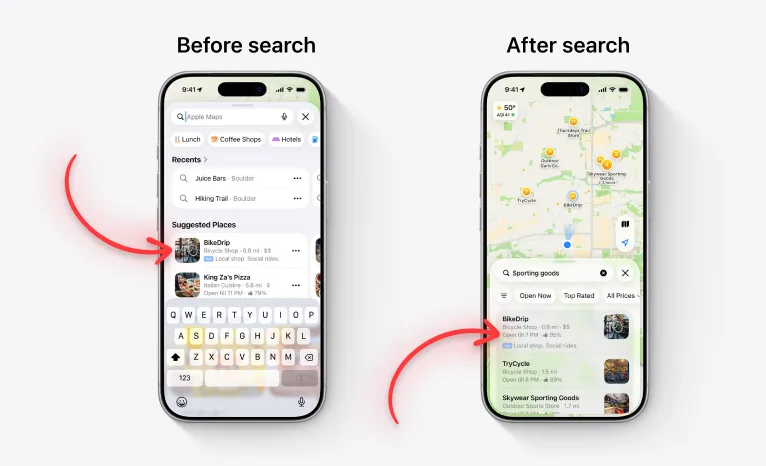
Apple Maps Ads can appear in two places
Apple Maps Ads can appear in two main moments of the Maps discovery journey.
1. Suggested Places: before the user searches
The first placement appears in Suggested Places while someone is beginning to explore Apple Maps.
This is the more discovery-oriented placement.
The user has not necessarily typed a specific query yet, so the ad has to create interest before the person has fully decided where they want to go.
2. Search results: after the user searches
This is the placement I would pay the most attention to.
After someone searches for a relevant type of business, an ad can appear at the top of the results.
This is high-intent inventory.
Someone searching for a restaurant, store, gym, or another local business is already telling Apple what they want.
For marketers coming from Apple Ads on the App Store, this should sound familiar.
Search intent is the signal.
The advertiser's job is to be the best answer to that intent.
Why Apple Maps Ads matter for local acquisition
Apple Maps sits close to real-world intent. A user searching for a restaurant, hotel, gym, pharmacy, or store is often much closer to taking action than somebody passively scrolling through content.
That is what makes the channel interesting for performance marketers.
You are not only buying reach. You are buying visibility at the moment somebody is comparing options and deciding where to go.
The strategic opportunity is the same one that makes search advertising powerful elsewhere: match a relevant business to an existing need.
How do you advertise on Apple Maps?
For businesses, Apple has made the setup relatively simple through Apple Business.
The basic process is:
- Set up your organization in Apple Business.
- Claim and verify your business locations.
- Upload photos and complete your business information.
- Create an ad.
- Choose the locations you want to promote.
- Set a monthly budget maximum.
- Add a payment method and launch the campaign.
Apple's official setup documentation confirms that businesses can choose a suggested budget or enter their own monthly maximum, and campaigns can be started or stopped at any time.
I would not rush directly to the ad creation screen, though.
Your Apple Maps presence is part of the ad.
If your business information is incomplete, your photos are poor, or your listing does not make the location attractive, paying for more visibility will not fix the underlying problem.
The same principle applies to app marketing: buying traffic to a weak App Store product page usually just helps you lose money faster.
What do Apple Maps Ads look like?
Apple's ad creation documentation says advertisers can add images or a business logo to an ad.
You can choose up to three images or use a single logo. You cannot use both in the same creative setup.
Using three images can make your ad eligible for Apple's available search-result formats, including:
- a three-image format
- a one-image format
- a text-only format
Advertisers can also add optional promotional text.
The exact placement and format are selected automatically based on factors including the business category and what the customer is searching for.
That means marketers need to stop thinking about a single fixed ad creative.
You are giving Apple assets that may be assembled differently depending on the search context.
Creative will matter, but relevance will matter more
There is an easy mistake to make here.
Businesses can easily see an advertising placement and immediately start designing "beautiful ads."
That is not where I would start.
Apple Maps is a search product.
If someone searches for a bike shop, sushi, a hotel, or a specific type of store, they are looking for an answer.
Your job is to make the business look like the best answer.
That means your photos, promotional text, business category, location information, and overall listing need to reduce uncertainty quickly.
The creative should help the user answer questions such as:
- Is this what I am looking for?
- Is it nearby?
- Does this place look good?
- Is there a reason to choose it now?
- Can I get there easily?
This is closer to conversion-focused search advertising than traditional display advertising.
Branding still matters. But clarity comes first.
How much do Apple Maps Ads cost?
Be careful with generic articles that promise a universal "average Apple Maps Ads CPC" or "average Apple Maps Ads cost."
Costs can vary by market, business category, competition, and campaign setup, so a single benchmark is unlikely to tell you whether the channel will work for your business.
What Apple does confirm is that advertisers set a monthly budget maximum. Apple calculates that budget over an average 30.4-day calendar month, and the maximum can be adjusted later.
You can read the current budget rules in Apple's Apple Maps Ads budget documentation.
My recommendation is simple: use benchmarks as context, not as a forecast.
Start with a budget that is large enough to collect useful data but small enough that you are comfortable treating the campaign as a test.
Your objective is to build a benchmark for your own locations and category.
Apple Maps Ads vs Apple Ads on the App Store
These products sit under the same broader Apple advertising ecosystem, but they solve different problems.
Ads on the App Store:
- promote apps
- optimize toward app discovery and downloads
- can target App Store search intent
- send users into an App Store product page or app experience
Ads on Apple Maps:
- promote physical business locations
- reach people looking for nearby businesses
- can appear before or after a Maps search
- drive actions such as directions, calls, and visits
For app marketers, the biggest takeaway is not that you suddenly have another app-install placement.
You do not.
The bigger story is that Apple Ads is becoming a broader advertising platform.
Apple has high-intent advertising surfaces across the App Store and Maps, alongside advertising opportunities in other Apple properties.
That is worth watching closely.
The real opportunity: Apple is monetizing intent
Apple Maps Ads make sense when you look at them through the same lens as App Store search ads.
The valuable asset is not the screen.
It is the intent.
On the App Store, someone searches for an app because they want to solve something.
On Maps, someone searches for a business because they want to go somewhere or do something.
In both cases, Apple sits between the intent and the action.
Now advertisers can pay to compete in that moment.
That is why I expect the search-results placement to be much more interesting than marketers simply buying visibility in Maps.
The closer the ad is to a real decision, the more valuable that impression can become.
What businesses should do before running Apple Maps Ads
If you operate a physical business in a market where Apple Maps Ads are available and Maps generates meaningful discovery in your category, prepare the business listing before you spend.
Do these things before worrying about advanced campaign strategy:
- Claim and verify your locations in Apple Business.
- Make sure every location has accurate information.
- Upload strong, current photos.
- Prepare promotional copy focused on user intent, not generic branding.
- Decide which locations are worth promoting first.
- Set a controlled test budget.
- Define what a successful Maps campaign means for your business.
And most importantly, do not judge the channel after only a few days.
Performance will vary by location, category, competition, and customer intent. Give the campaign enough data to learn whether it can generate valuable actions for your business.
Final thoughts
Apple Maps Ads are an interesting part of Apple's advertising ecosystem because they connect paid visibility with local search intent.
Not because Apple invented local search ads. Google has been doing this for a long time.
What makes it interesting is where Apple is placing the ads: inside a product where users are already expressing local intent and are often only a few taps away from calling a business or getting directions.
For marketers, the strategy should be familiar.
Do not advertise simply because the placement exists.
Advertise when you can match the user's intent better than the businesses around you.
That is what will decide whether Apple Maps Ads become another expensive channel or a genuinely useful acquisition source.
Sources
Free starter guide
Ship your first Apple Ads campaign in 2 hours.
Most guides make Apple Search Ads sound like a project. It's not. This is the exact setup I use with every new client: campaign structure, keyword match types, starting budget. Two hours, start to finish, no agency jargon.
One email. Unsubscribe anytime.
Keep reading
How to Advertise on Apple Maps: Complete Apple Maps Ads Guide
A practical guide to setting up Apple Maps Ads, choosing locations, adding creative, setting a budget, and preparing your Apple Business listing before you spend money
App Store Search Results Creative Asset: How to Win More Installs in iOS 27
Apple is adding custom image and video assets to App Store search results. Here is why this matters for ASO, Apple Ads, and competing for high-intent searches
Apple Adds New App Store Creative Assets for iOS 27: Product Page Headers and Search Results
Apple is adding new image and video placements to App Store product pages and search results. Here is what app marketers should prepare before iOS 27 rolls out
App Store Product Page Header: How to Use Apple's New iOS 27 Creative Asset
The new App Store Product Page Header gives apps a major image or video placement above the rest of the listing. Here is how to use it for ASO, conversion and Apple Ads